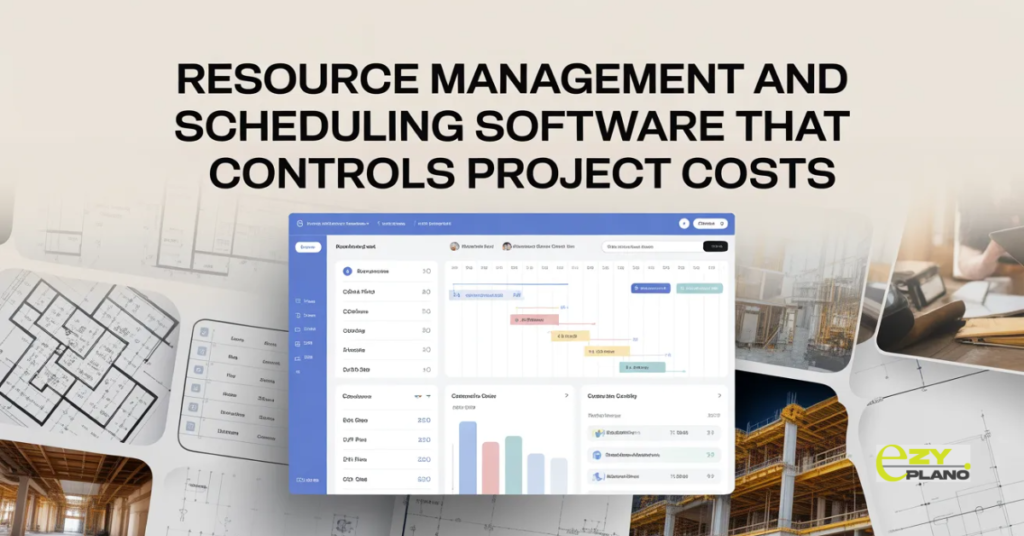
Resource Management and Scheduling Software That Controls Project Costs
- Resource management is where project planning and financial control meet. Every resource has a cost. Every scheduling decision that allocates resources has financial implications. Managing resources well is not just about making sure the right people and equipment are in the right place at the right time. It is about controlling the cost of delivering the project against the budget that was committed to at the start.
- Resource management and scheduling software that serves construction and project based businesses properly connects these two dimensions. Not scheduling that ignores cost and not financial tracking that is disconnected from how resources are actually being deployed. A system that makes the relationship between resource allocation decisions and their financial consequences visible in real time rather than at the end of the month when the opportunity to manage them has already passed.
Why Resource Management Is Harder Than It Looks
- Resource management looks straightforward in theory. Know what resources you have. Know what work needs to be done. Match one to the other. In practice the complexity compounds quickly.
- Resources are shared across multiple activities and multiple projects simultaneously. A project manager who is responsible for two projects. A crane that serves multiple lifts across different areas of a large site. A specialist subcontractor whose team is split between two concurrent packages. Managing these shared resources requires visibility across all the demands on them simultaneously rather than optimising each activity in isolation.
- Resource availability changes constantly. A team member who is sick for a week. Equipment that needs unplanned maintenance. A subcontractor who is delayed on their previous project and cannot start when the programme requires. These changes need to be reflected in the resource plan and the project schedule in real time rather than being discovered when the resource fails to appear.
- The relationship between resource allocation and project cost is not always immediately obvious. Overtime that is needed to recover a programme delay. Additional plant that is hired to accelerate earthworks. Prolongation of preliminaries because the project is running late. These resource cost implications of scheduling decisions are often only visible when the financial impact has already been incurred rather than when the scheduling decision that created them was being made.
What Resource Management Software Actually Needs to Do
- The capabilities that matter most in resource management and scheduling software for construction and project based businesses reflect the specific resource management challenges these businesses face.
- Resource capacity planning across projects. Understanding what resource capacity exists across the full project portfolio and how it is currently committed. A business running multiple concurrent projects needs to know whether it has the resources to take on additional work, whether specific resources are overcommitted and where the scheduling decisions made on one project are creating constraints on another.
- Skill and capability matching. Not just whether a resource is available but whether the available resource has the right capability for the activity they would be allocated to. A labourer cannot do the work of a skilled electrician. An excavator of insufficient capacity cannot handle the material classification being encountered. Resource allocation that matches capability to requirement produces better outcomes than allocation that fills slots with whatever is available.
- Real time utilisation tracking. Understanding how resources are actually being used against how they were planned to be used. Utilisation data that is always current rather than calculated from timesheets submitted at the end of the week. The gap between planned and actual utilisation is where cost overruns originate and where programme risks develop. Identifying that gap in real time creates the opportunity to respond before it has become significant.
- Cost integration. Resource allocations connected to cost rates that produce the financial picture of the project automatically rather than requiring separate cost calculation alongside the scheduling work. When a resource is added to an activity the cost implication should be immediately visible. When a resource is used beyond their planned allocation the cost variance should surface in real time.
- Conflict identification and resolution. Automated detection of resource conflicts before they affect delivery. Two activities that require the same resource at the same time. Demand that exceeds available capacity in a specific period. These conflicts are manageable when they are identified before the work starts and much more expensive when they are discovered when the resource fails to show up.
The Multi-Project Resource Challenge
- For businesses managing multiple concurrent projects the resource management challenge is qualitatively different from managing resources on a single project.
- Individual project scheduling that does not account for resource constraints across the full portfolio creates conflicts that only become visible when two project managers both expect the same resource to show up at the same time. The project manager of each project may have made sensible scheduling decisions in isolation. The aggregate resource demand those decisions create may significantly exceed available capacity.
- Resource management and scheduling software that provides visibility across multiple projects simultaneously changes the terms of that challenge. Resource allocation decisions made in the context of the full portfolio rather than in the context of individual projects produce schedules that are achievable given actual resource availability rather than optimistic given assumed unlimited resources.
- The business development dimension of multi-project resource management matters alongside the operational one. Understanding current and committed resource utilisation before quoting a new project determines whether the project can be delivered as planned or whether the resource constraints of the existing portfolio will affect it. Businesses that understand their resource position accurately make better commercial decisions than those who discover resource constraints after they have committed to a project.
Labour Scheduling in Construction
- Labour scheduling is where resource management and scheduling software has the most direct impact on construction project cost control.
- Labour is typically the largest controllable cost on a construction project. Variation in labour productivity, unexpected overtime and inefficient labour deployment are among the most consistent sources of cost overrun. Managing them requires information about how labour is being deployed and performing that most businesses do not have in real time.
- Daily labour planning that connects to the programme rather than being made independently of it. Which trades are required on which day. What they are expected to accomplish. Whether the conditions for them to work productively are in place. This planning is often done informally based on experience rather than from a system that tracks it against the programme and the budget simultaneously.
- Labour performance tracking that compares actual output against planned output provides the early warning of cost risk that allows management intervention before the cost has been fully incurred. A trade that is taking significantly longer than planned on a specific activity is a signal that deserves investigation. Is the activity more complex than estimated. Is there a design issue affecting productivity? Is there a plant or material issue preventing efficient working. These questions answered early produce better outcomes than the same questions answered at monthly valuation when the cost has already been incurred.
Plant and Equipment Resource Management
- Plant and equipment management is the resource management dimension that most often gets handled separately from the labour and programme management rather than as part of a connected system.
- Plant utilisation data that is separate from the programme creates the situation where a plant is on site and costing money while the programme shows it is not needed for several days. Or where the programme shows a plant is needed and nobody has confirmed it is available and booked. Both situations represent cost that proper connected resource management avoids.
- Maintenance scheduling that connects to the programme prevents maintenance requirements from creating unplanned availability gaps at programme critical moments. A crane that is due for its statutory inspection during a critical lifting programme is a known risk that can be managed with advance planning. The same crane inspection arriving as a surprise during the critical programme period is a costly disruption.
Getting More From Resource Management and Scheduling Software
- The construction businesses that control their resource costs most effectively are not the ones with the most sophisticated resource management systems. They are the ones whose resource management is most connected to their project scheduling and their financial control.
- Resource management and scheduling software that delivers that connection produces the integrated picture of project delivery that allows management decisions to be made with accurate current information rather than with information that is always slightly behind what is actually happening.
- EZY PLANO is a platform built for construction businesses that want resource management connected to project scheduling in a way that makes the relationship between scheduling decisions and their cost implications visible rather than discovered retrospectively. Designed for the realities of managing resources across multiple concurrent projects where the aggregate resource picture matters as much as the individual project view.
Questions Worth Asking
How do we manage resource conflicts across multiple projects without a dedicated resource manager?
- A platform that provides visibility across all active projects simultaneously and flags resource conflicts automatically does the conflict identification work that would otherwise require a dedicated resource manager. The project manager still makes the resolution decisions but the system identifies the conflicts rather than leaving them to be discovered operationally.
How do we connect resource scheduling to cost control without creating double entry?
- Resource allocations that are connected to cost rates within the same system produce the financial picture automatically rather than requiring separate cost calculation alongside the scheduling work. The connection between who is allocated to what and what that costs should be automatic rather than manual.
How do we handle resource shortages that affect the programme without the whole schedule falling apart?
- Planning tools that understand dependencies and can model the programme impact of resource constraints produce more useful information than those that simply flag that a resource is overcommitted. Understanding which activities can be deferred without affecting the critical path versus which ones cannot is what allows effective response to resource shortages.