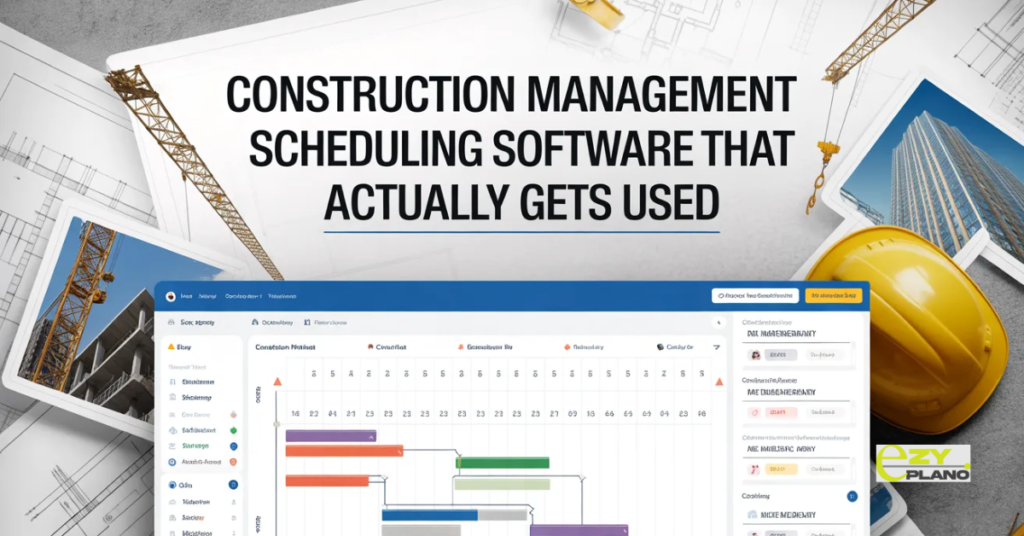
Construction Management Scheduling Software That Actually Gets Used
- Every construction business reaches a point where the way they have been managing schedules stops working. The spreadsheet that the project manager updates manually. The WhatsApp group where everyone posts updates. The printed programme pinned to the site office wall that nobody has touched since the project started. These approaches have a ceiling and most growing construction businesses hit it eventually.
- Construction management scheduling software is supposed to solve that. And it does when the right platform is in place and the whole team is actually using it. The problem is that a lot of businesses invest in scheduling software and then find that six months later only the project manager is updating it while everyone else has gone back to calling each other.
- This guide is about what actually separates the platforms that get used consistently from the ones that become expensive background software.
Why Scheduling Software Fails on Construction Sites
- Before getting into which platforms are worth considering it is worth being honest about why scheduling software fails in construction specifically. Because the reasons are consistent and they are not about technology.
- The update process takes too long. When logging progress on an activity requires navigating multiple screens on a desktop computer in the site office it does not get done. The site supervisor is not going to stop what they are doing mid-afternoon to find a computer and update a programme. The update gets deferred. Then deferred again. Then the programme is two weeks out of date and nobody trusts it anymore.
- The mobile experience does not work on site. There is a difference between a mobile interface that technically exists and one that actually works in site conditions. Poor connectivity. Bright sunlight on a screen. Wearing gloves. Time pressure. A lot of scheduling platforms have a mobile version that works fine in a demo and falls apart when someone tries to use it standing next to an excavator.
- Subcontractors cannot access it simply. Most subcontractors work across multiple projects with multiple principal contractors all using different systems. If accessing their schedule on your platform requires a 20 minute setup process and navigating something complicated they will just call the office instead. When subcontractors bypass the system the coordination benefit disappears.
- The programme does not reflect how construction actually works. Generic task management tools treat all dependencies the same. On a construction project some dependencies are physically non-negotiable. You cannot pour the slab before the blinding is done. You cannot fix the cladding before the structural frame is complete. A scheduling tool that does not understand and enforce these physical constraints is not really a construction scheduling tool.
What Good Scheduling Software Actually Does
- Construction management scheduling software that works on real projects has a few things in common that are worth knowing before you start evaluating options.
- Updating the programme is fast. Not faster than not updating it which is always the fastest option but fast enough that a site supervisor can do it from their phone in a couple of minutes between tasks. That is the bar. If it takes longer than that it will not happen consistently.
- The whole team can see the same current programme. Not the version from last week. Not the version the project manager emailed around. The live programme that reflects what was updated this morning. When everyone is working from the same current picture the coordination benefit is real.
- Dependencies are enforced not just noted. The construction sequence is not a suggestion. Good scheduling software reflects that and flags when the programme assumes something is possible that physically is not.
- Subcontractors get simple access. They can see their upcoming work, confirm their schedule and flag problems without navigating a complicated system. This is what turns scheduling software from a project management tool into an actual coordination tool.
- The programme connects to the rest of how projects are managed. Drawings when they are revised. Costs when commitments are made. Issues when they are raised. A schedule that sits in isolation from these other project information streams is less useful than one that connects to them.
The Platforms Worth Knowing
- Primavera P6 is the one that gets mentioned whenever someone asks about enterprise construction scheduling. The depth of scheduling capability for massive complex programmes is genuine. Multi year infrastructure projects with thousands of activities and complex resource management. If that is your world Primavera earns its place.
- For most growing construction businesses it is overkill. The learning curve alone puts it out of reach for teams without a dedicated planner and the ongoing management overhead is significant. Worth knowing about but not worth evaluating unless your projects genuinely need that level of complexity.
- Asta Powerproject is widely used in UK construction for a good reason. It was built for construction scheduling specifically rather than adapted from a generic project management tool. The dependency management and trade sequencing reflect how construction projects actually work. More accessible than Primavera without losing the construction specific depth. If your team has a planner with some scheduling experience this is a serious option.
- Microsoft Project shows up in a lot of construction businesses because it is already available through Microsoft licensing. The Gantt chart capability is adequate for straightforward projects. The mobile experience is poor, the construction specific features are limited and it was not designed for field team access. It gets chosen because it is familiar and already paid for rather than because it is the best fit.
- Procore includes scheduling within its broader construction management platform. The integration between scheduling and the rest of Procore is genuine and valuable. For businesses already using Procore across their operation this is a natural extension. For businesses evaluating scheduling specifically the full Procore commitment is a big ask.
- Buildertrend serves residential construction well. Scheduling, client communication and job costing sitting together in one platform. Very practical for home builders and renovation contractors. Less suited for commercial construction where the coordination complexity is higher.
- EZY PLANO was built for growing construction businesses that have outgrown basic tools but are not at the scale where enterprise platforms make sense. Construction specific scheduling with physical dependency management. Mobile access that was designed for site conditions not just adapted for them. Subcontractor access is simple enough that external parties actually use it. AI features that flag programmed risks without requiring a dedicated planner to interpret them. Integration with document management and team coordination rather than scheduling as a standalone function.
The Mobile Question Is Not Optional
- Mobile access in construction scheduling is not a nice to have feature. It is the thing that determines whether the programme stays current or drifts.
- The project manager is not always at a desk. The site supervisor is almost never at a desk. The subcontractor arriving on site to start their package is definitely not at a desk. If these people cannot access and update the programme from wherever they are the programme will only ever reflect what the project manager knows rather than what is actually happening.
- The mobile experience worth evaluating is not the one shown in a vendor demo in a wifi-connected office. It is the one that works on a 3G connection in bright sunlight when someone has 90 seconds between tasks. That is the test that actually matters.
Subcontractor Coordination Is Where the Real Value Is
- A construction schedule that only the principal contractor’s team engages with is a planning document. A schedule that subcontractors also access and contribute to is a coordination tool. The difference between these two things is the difference between a programme that shows what you intended and one that reflects what is actually going to happen.
- Getting subcontractors to engage consistently requires the access to be genuinely simple. Seeing their upcoming work. Confirming they can make the dates. Flagging when something changes on their end. These three things in under a minute from a phone is the standard worth aiming for. Anything more complicated than that and you will be chasing updates by phone instead.
AI Features That Are Actually Useful
- Most scheduling platforms in 2026 have AI in their marketing. Fewer have AI that genuinely changes how planning teams work. The ones worth paying attention to produce specific outputs rather than general ones.
- A flag that says this specific activity is at risk because it has no float and depends on a subcontractor who has not confirmed availability is useful. A general observation that the project carries scheduling risk is not.
- Progress prediction based on how the project is actually performing rather than on planned progress is useful. A dashboard that shows the programme is 73 percent complete when the project manager already knows that is not.
- Resource conflict detection that surfaces overallocation before it causes a problem on site is useful. A resource chart that shows what everyone already knows is not.
- The AI features worth having make the project manager smarter about what is coming. The ones not worth having just display information they already have in a different format.
Getting the Transition Right

- Switching to new construction management scheduling software mid-project is a recipe for problems. The best approach is almost always to start new projects on the new platform while finishing existing ones through the current approach.
- This gives the team time to build familiarity without the stakes being as high as they would be on a live project in delivery. By the time the new platform is carrying the full portfolio the team has the confidence that comes from having used it on something real already.
- EZY PLANO is a platform built for construction businesses that want scheduling to be a live management tool rather than a document produced at project start and ignored from then on. Built for teams that work on site as much as in the office and for coordination across external parties who need simple access rather than sophisticated ones.
Questions Worth Asking
How do we evaluate mobile experience properly rather than just taking the vendor’s word for it?
- Put it in the hands of a site supervisor and ask them to do the things they actually need to do on an active site. Update progress. Check tomorrow’s activities. Flag a problem. Their experience in real conditions tells you more than any demo.
How do we get subcontractors to actually use the system rather than calling the office?
- Make the access genuinely simple and show them what is in it for them. Subcontractors who can see their confirmed schedule without making a phone call and who get notified when it changes are subcontractors who have a reason to engage with the system.
What is the minimum the team needs to do to keep the programme useful rather than letting it drift?
- Define this before choosing a platform. The platform where that minimum is achievable in the time the team actually has will be used. The one that requires more than they can realistically give will drift.