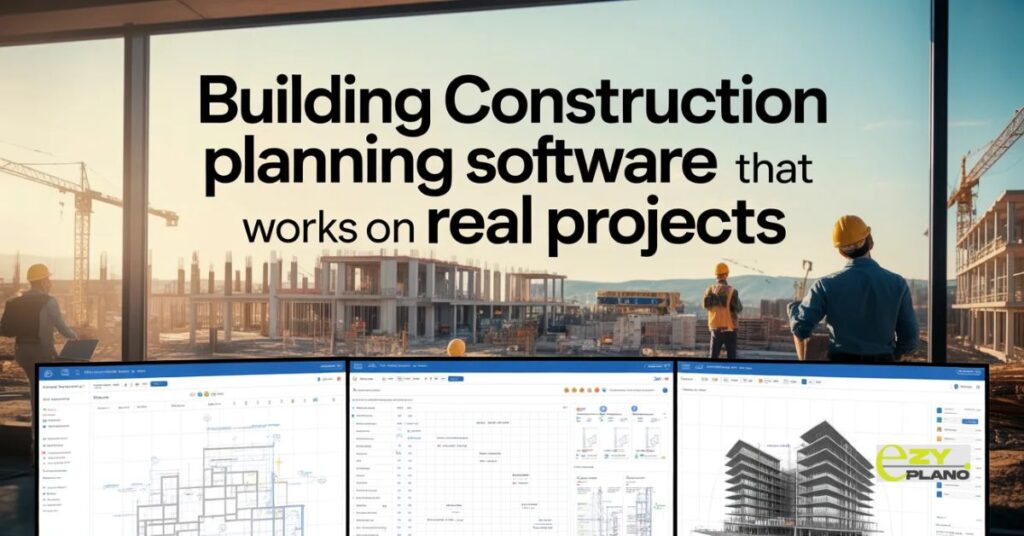
Building Construction Planning Software That Works on Real Projects
- Construction planning has a reputation for being the part of a project that gets done once at the start and then ignored until something goes wrong. A schedule gets produced. It looks convincing. The project begins. Reality immediately starts diverging from it and nobody updates the plan to reflect what is actually happening.
- That pattern is not caused by bad intentions. It is caused by planning tools that make updating the plan feel like more work than just getting on with things. When the friction of maintaining a plan exceeds the perceived benefit of having one current the plan gets abandoned.
- Building construction planning software that actually gets used consistently is built around removing that friction. Not producing the most sophisticated schedule possible at kickoff. Making it genuinely easier to keep the plan connected to what is happening on site throughout the life of the project.
Why Construction Planning Is Different
- Planning a building project is not the same as planning other types of work.
- The dependencies are physical rather than flexible. Foundations before structure. Structure before envelope. Envelope before fit out. These sequences are not preferences. They are constraints imposed by physical reality. A planning tool that does not understand sequencing at this level of rigidity produces schedules that look organised but do not reflect how construction actually works.
- Weather affects outdoor work in ways that office based project management tools do not account for. A planning system that cannot absorb a weather delay and show its implications across the schedule requires manual recalculation every time conditions change.
- Multiple parties with different schedules and different priorities need to coordinate around a single project timeline. Trades that depend on each other. Suppliers whose delivery windows need to align with when their materials are actually needed. Inspectors whose availability affects when work can progress. A planning tool that does not accommodate this level of external dependency coordination leaves the project manager managing it manually.
What Current Information Actually Changes
- The value of keeping a construction plan current is not about having accurate records. It is about making better decisions.
- When the plan reflects what is actually happening the project manager can answer the questions that drive those decisions. A subcontractor is running two days behind. What else does that affect and when. A material delivery has been delayed by a week. What needs to move and what can continue. A new variation comes in. Where does it fit in the remaining programme and what does it displace?
- Without a current plan these questions get answered through experience and judgment rather than information. Experience and judgment are valuable. They are more valuable when they are applied to accurate information rather than compensating for the absence of it.
- Building construction planning software that is easy enough to update that it actually stays current gives the project manager that informational foundation for every decision rather than just the ones that happen to coincide with a planned review.
The Site Team Connection
- Construction planning that lives only in the project manager’s office is only half a planning system.
- The people whose work the plan describes are on site. Their progress is what determines whether the plan is accurate. Their awareness of what is planned for tomorrow and next week is what allows them to prepare properly rather than discovering requirements at the last moment.
- A planning tool that the site team can access and update directly removes the project manager as the intermediary for every information exchange between site and office. Progress gets logged where the work happens. Changes to the plan reach the people affected by them without requiring a phone call or a site visit to communicate.
- That direct connection between site activity and the planning system is one of the most significant practical improvements that good building construction planning software delivers. It is also one of the most consistently underinvested in aspects of construction planning tool selection.
Subcontractor Coordination Without the Overhead
- Most building projects involve more subcontractors than the project manager can realistically coordinate manually at the level of detail that prevents conflicts.
- Each trade has its own schedule. Its own priorities. Its own understanding of when it needs to be on site and for how long. Coordinating those individual schedules into a coherent project timeline requires constant communication when it is done manually. Updates that need to reach multiple parties. Changes that affect some trades but not others. Dependencies that shift when one trade runs ahead or behind.
- Good construction planning software makes each subcontractor’s relevant schedule visible to them without requiring the project manager to communicate every change individually. A schedule update flows through to everyone affected automatically. The project manager manages exceptions and decisions rather than serving as the communication hub for every interaction between trades.
Document Connection
- A building project plan that is not connected to the drawings and specifications it is based on has a gap in it.
- A revision to a drawing affects work that is currently planned. If the planning system does not reflect that connection the project manager has to track it manually. A change in specification affects procurement lead times that feed into the schedule. Without that connection being visible in the planning tool the impact of design changes on the programme gets discovered late rather than early.
- Building construction planning software that connects the plan to project documentation brings those implications to the surface automatically. A drawing revision flags its potential impact on planned work. A specification change shows where its downstream effects sit in the programmed. The project manager sees the full picture rather than assembling it from separate systems.
Getting the Most From Building Construction Planning Software
- The building projects that consistently run closer to programme and budget than average are not managed by people with more experience or better judgment than everyone else. They are managed with better information. Current plans that reflect reality. Visibility into problems while they are still manageable. Decisions made on accurate information rather than outdated assumptions.
- Building construction planning software is what makes that quality of information available throughout a project rather than just at the start and at the review points when things have already gone wrong.
- EZY PLANO is a platform built for construction businesses that want that level of planning visibility without the complexity of enterprise scheduling software. Practical planning tools that work for the project manager in the office and the site supervisor on site. Built for how building projects actually run rather than how they look in a perfectly sequenced theoretical programmed.
Questions Worth Asking
How do we keep the plan current when the site team is too busy to update it regularly?
- Make updates take less time than the alternative. A progress update that takes thirty seconds on a phone gets done. One that requires logging into a desktop system and navigating multiple screens does not. Mobile first design is not a nice feature for site use. It is what determines whether the plan stays current.
How do we handle a project where the design is still evolving as construction progresses?
- Look for software that makes it straightforward to adjust the plan as design decisions are made rather than requiring the schedule to be rebuilt every time something changes. Flexibility in replanning is more valuable on live projects than precision in the original schedule.
What is the right level of detail for a building construction plan?
- Enough detail to show dependencies clearly and identify conflicts before they become problems. Not so much that maintaining the plan becomes a full time role. The test is whether the plan is being used to make decisions. If it is, the detail level is right. If it is too complicated to keep current it has too much.